
Anxiety in the City: Why So Many Boston Professionals Are Quietly Struggling

I see a particular kind of patient often enough now that I recognize them on the intake call. They have a job most people would consider impressive — a research role at a teaching hospital, a partner-track position, a senior engineer title at a Kendall Square biotech. They sleep poorly but blame it on coffee. They describe themselves, when pressed, as "a little wound tight" — and they laugh while they say it.
They are not in crisis. That is part of the problem. They have been managing for so long that the management has started to feel like their personality.
This is what high-functioning anxiety looks like in Boston. There is a great deal of it here.
Why this city, specifically
Boston rewards a particular kind of person. Academia, biotech, finance, medicine, law, consulting, tech — the dominant industries run on intelligence, output, and a quiet, relentless pressure to keep performing. The culture absorbs that pressure and presents it back as virtue. Hard work is moral. Self-doubt is private. Asking for help is something you do as a last resort, after the wheels have come off.
The people I see in my practice are often the ones who never let the wheels come off. They learned early that being okay was their job. That their value was located in how well they performed. By the time they get to me, they are in their thirties or forties or fifties, with careers that look correct from the outside, and they cannot remember the last time they felt at rest in their own body.
Anxiety isn't always the trembling, can't-breathe version. Sometimes it's just a low electrical hum you've decided is normal.
What anxiety actually is
Clinically, anxiety isn't just worry. It's a physiological state — a sympathetic nervous system response, the body's threat-detection system firing when there isn't an actual threat in the room. The spinning thoughts, the catastrophizing, the rehearsal of conversations that may never happen — all of that is downstream of the bodily part.
This is why anxiety is so hard to think your way out of. The body got there first. The thoughts are the body's way of finding something to be alarmed about, after the alarm is already ringing.
For high-functioning people, the body learns to keep the alarm on quietly, in the background, for years. It becomes the baseline. You attribute the tight jaw, the shallow breathing, the inability to fall asleep without your phone — you attribute all of it to being busy, or to "just how I am."
You do not notice it until something forces you to. A relationship strain. A health scare. A free Saturday when there's nothing to do and you do not know how to be in your own body without a task.
What I actually do with this in session
My practice is trauma-informed and CBT-based, which is jargon, so let me translate. We do two things in parallel.
First, we look at the thoughts — the assumptions running underneath the anxiety. Things like if I stop pushing, I'll fall behind or I am only valuable when I am useful or rest is something I earn. These beliefs are old. They came from somewhere — childhood environments where being okay required achievement, or where slowing down was unsafe. We trace them. We test them against reality.
Second, we work with the body. We pay attention to what the nervous system is doing. Not mystically — practically. Where do you feel it? When does it spike? What soothes it and what doesn't? CBT alone, without this piece, often doesn't go deep enough. The thoughts are real, but the body got there first.
A note for the high-performers reading this
If you are someone who has been managing for a long time, you may be skeptical of therapy on principle. You may worry that if you slow down and look at all of this, the structure will collapse — the career, the productivity, the version of you that works.
It won't. In thirty years of practice, I have not seen a single person dissolve because they finally let themselves rest. What I have seen is people get steadier, sleep better, like themselves more, and — to their surprise — get better at the work they were so afraid of losing. The work doesn't require the anxiety. The anxiety has just been alongside it for so long the two got confused.
You don't have to be in crisis to come in. The whole point of doing this work earlier rather than later is that the wheels don't have to come off.
Fay White, M.Ed., is based in Boston and offers virtual sessions across Massachusetts.
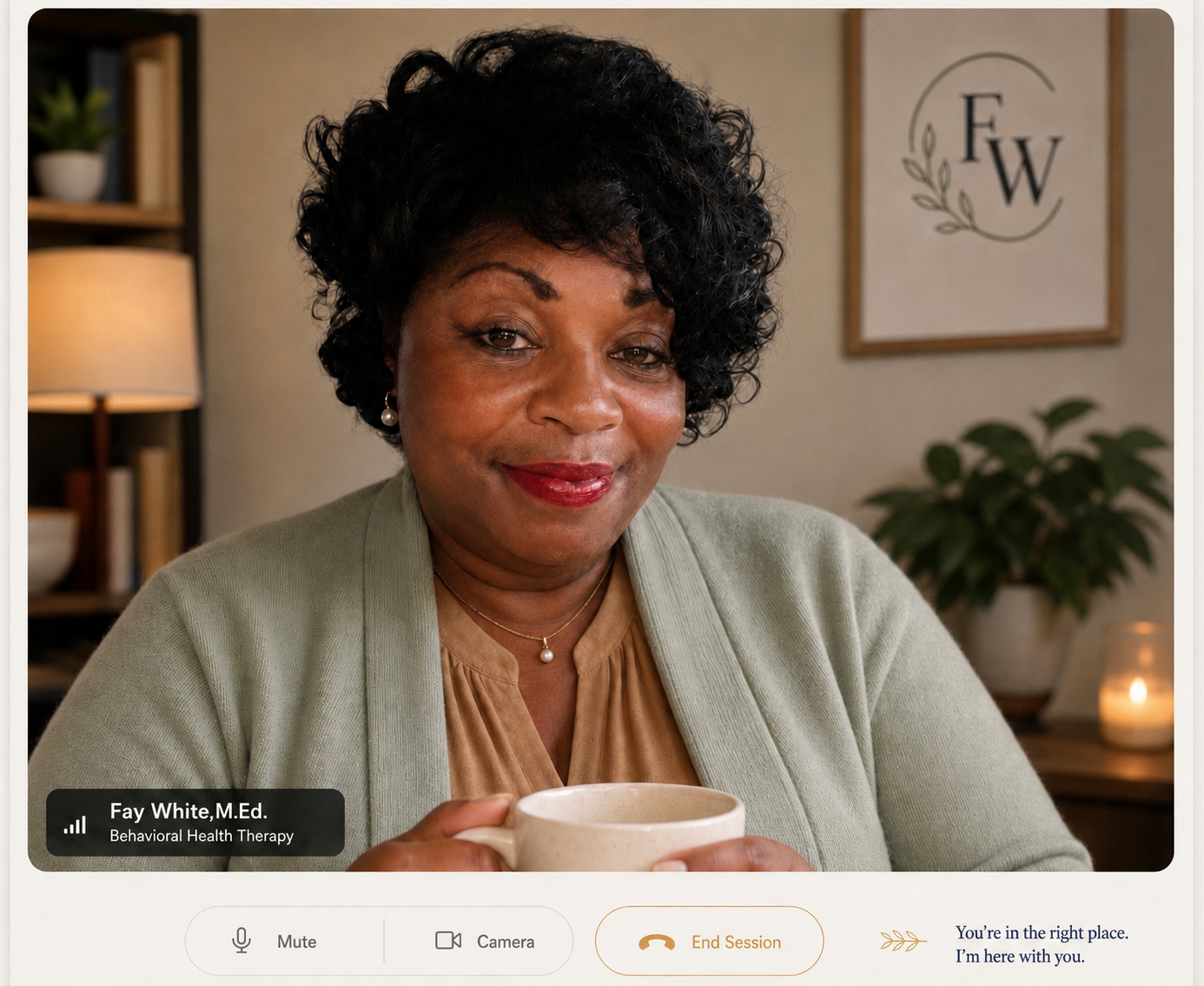
Fay White, M.Ed.
LADC1 · Licensed MA · Based in Boston
Fay White has spent over 30 years counseling Massachusetts clients on behavioral health. She built her practice one client at a time, staying small by choice, and staying focused on the kind of work that actually moves people forward.
Book a free consultation