
Finding a Therapist in Boston: What 30 Years of Practice Has Taught Me About Fit

People ask me all the time: how do I find the right therapist? Most advice is practical — check credentials, verify insurance, read the specialties. All of it matters. But after three decades of practice in the Boston area, I want to tell you something that doesn't show up on any directory.
The most important variable is almost never the modality. It's not whether someone is CBT or psychodynamic or EMDR. It's whether you feel, within the first two or three sessions, like you could tell this person something you're ashamed of — and not have to manage their reaction while you're doing it.
Fit isn't a vibe. It's your nervous system telling you whether it's safe to do the actual work.
What "fit" actually means in clinical terms
The research on what makes therapy work is unusually consistent. Meta-analyses going back to Bruce Wampold's foundational work show that the therapeutic alliance accounts for more outcome variance than any specific technique. The alliance is the quality of the relationship — whether you feel understood, whether you agree on the goals, whether you trust the process.
In plain language: how you feel with your therapist matters more than what method they use. Technique still matters — a trauma-trained clinician works with PTSD differently than a generalist — but the alliance is the substrate everything else rests on. Without it, even the best technique falls flat.
Real fit is quieter than "liking your therapist." It's the sense that someone can hold what you bring without flinching. That they can sit with hard material without rushing to fix it. That they don't redirect you toward reassurance before you've finished the thing you came in to say. You can tell the truth, and the truth doesn't have to be performed.
Why this matters more in Boston specifically
Boston is a particular environment to find therapy in. The metro is dense with highly educated, high-achieving people. The dominant industries — academia, biotech, medicine, law, finance, tech — select for an analytical, controlled, very fluent cognitive style. The people I see are often extraordinary at thinking about their feelings. They have read the books. What they often cannot do, at first, is feel any of it in the room with another person without immediately analyzing it.
A therapist who can match your intellectual register without colluding with your avoidance is genuinely important here. There are clinicians in this city who will let a sharp client run the session, accept the polished narrative, mirror back the intellectualization. You leave feeling productive. You are not actually doing therapy.
From Cambridge to Brookline to Dorchester to the South Shore, there are excellent therapists across every modality. The key is giving yourself permission to switch if the first one doesn't fit. Most people don't switch — they feel embarrassed to start over, worried about hurting feelings, convinced the problem is them. The problem is rarely you.
A few things I'd tell a friend
Do at least two sessions before deciding. First sessions are awkward by design. The real read comes in session two or three.
Notice if you're performing. If you find yourself editing your story to make it more interesting, say so out loud. A good therapist will be glad you noticed.
Feeling understood and feeling comfortable are not the same thing. Good therapy can be uncomfortable and still right.
Trust what your body tells you in the room. Are your shoulders lower at the end of the session, or higher? Your nervous system is paying attention even when your mind is reasoning.
Ask about pacing. Especially if you have any history of trauma or anxiety. The answer should involve "choice," "checking in," and "slowing down."
On access in Massachusetts
Massachusetts has stronger mental health parity laws than most states, and MassHealth coverage is among the best in the country. Many private plans cover outpatient therapy. If your plan doesn't cover the therapist you want, ask about sliding scale — many of us hold a portion of our caseloads at reduced rates.
For clients in Boston, Dorchester, Mattapan, Roxbury, and surrounding neighborhoods where the per-capita ratio of available therapists is low, telehealth has genuinely changed access. You no longer have to travel into Back Bay or Brookline to see a good clinician.
The first therapist you talk to does not have to be the one. The decision to start therapy is the hard part. The choice of who to do it with is something you are allowed to take seriously, take your time on, and revise.
Fay White, M.Ed., is based in Boston and offers virtual sessions across Massachusetts.
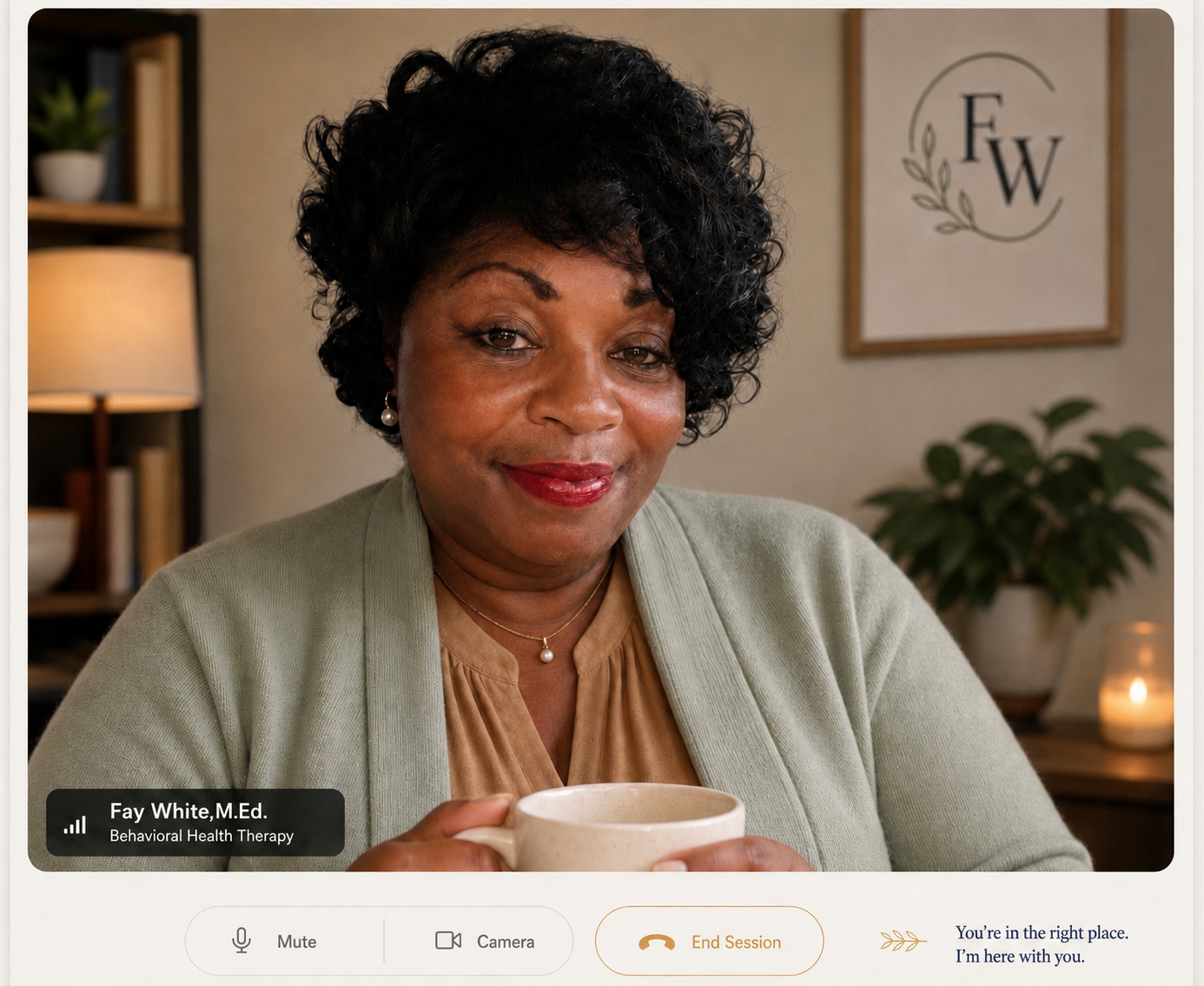
Fay White, M.Ed.
LADC1 · Licensed MA · Based in Boston
Fay White has spent over 30 years counseling Massachusetts clients on behavioral health. She built her practice one client at a time, staying small by choice, and staying focused on the kind of work that actually moves people forward.
Book a free consultation
